

christening,finished.Table of Contents
- What Makes Bespoke Children's Clothing Different
- The Bespoke Christening Gown Design Process
- How to Measure a Child for Formal Wear
- Custom Flower Girl Dress Timeline: What to Expect
- Choosing Fabrics and Details for Heirloom Quality
- What to Check Before You Order Bespoke Children's Clothing
- Conclusion: Your Bespoke Order Starts Here
- Frequently Asked Questions
Last Updated: September 18, 2026
What Makes Bespoke Children's Clothing Different
Bespoke children's clothing is made to a single child's measurements and design choices, not pulled from a standard size run. That difference shows up in fit, comfort, and how long a garment lasts.
At MTK Australia, every gown starts with an individual pattern. Nothing is cut until your child's numbers are on paper.
Here's what sets bespoke apart:
- Fit accuracy: the garment follows your child, not a generic size chart
- Fabric selection: you choose the cloth, lace, and lining
- Garment construction: each piece is cut and sewn for one wearer
- Keepsake value: a handcrafted gown is often kept for the next generation
Off-the-rack works for a birthday party. For a Christening, a First Holy Communion, or a flower girl role, custom-made gives you control over every detail.
The trade-off is time. Bespoke takes weeks, not days. Plan for that early.
The Bespoke Christening Gown Design Process
The bespoke christening gown design process runs in three stages: consultation, design confirmation, and creation. Most gowns take 8 to 10 weeks from design approval, with some designs requiring 12 weeks.
Stage 1: Initial consultation. You book a 30-minute appointment, in store or online, to talk through your event date and ideas.
Stage 2: Design consultation. You share inspiration photos, or review the MTK Australia gallery. The designer helps you settle on silhouette, fabric, lace, and finishes.
Stage 3: Measurements and confirmation. You confirm a short list of numbers, then sign off on a design summary before work begins.
Then the gown goes to the workroom. You'll get a fitting or a progress update along the way.
One more option worth knowing: a sentimental wedding dress can be repurposed into a child's gown. That keeps the original fabric in the family.
How to Measure a Child for Formal Wear
Most guides tell you to "take the child's measurements" and stop there. That's the step where bespoke orders actually go wrong. Below is the full sequence, with the landmarks, the common errors, and the allowances that separate a gown that fits on the day from one that needs altering the week before.
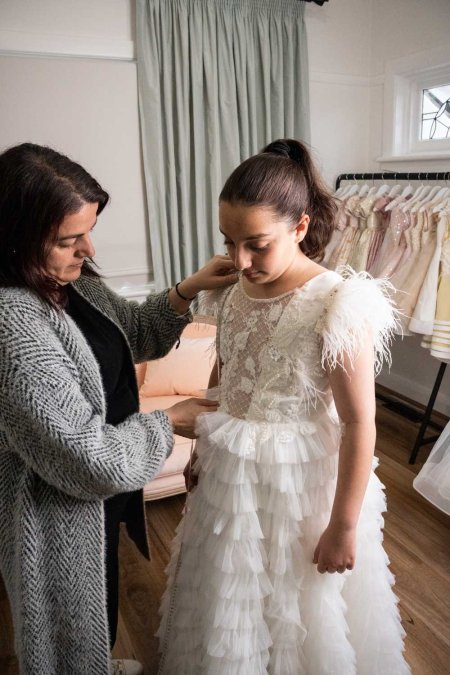
What you'll need: a soft dressmaker's tape (not a builder's tape, it won't curve), a thin ribbon or piece of elastic for the waistline, a notebook, and a second pair of hands if the child is under five.
Before you start
- Dress the child in light clothing or a singlet and leggings; bulky outfits add phantom centimeters.
- Have them stand straight, feet together, arms relaxed at the sides. Don't ask them to "stand up tall", children suck in and skew the chest number.
- Take every measurement twice, and if the two readings differ by more than 1 cm, take a third and use the middle figure.
- Measure in centimetres. Most Australian dressmakers work in centimetres, and converting from inches introduces rounding errors.
The five core measurements
1. Chest circumference. Wrap the tape around the fullest part of the chest, usually just under the armpits and across the shoulder blades. Keep the tape level all the way around; a tape that dips at the back adds 2-3 cm. Ask the child to breathe normally; don't measure on an inhale.
2. Waist circumference. Wrap the tape around the natural waist first. For children, the natural waist sits roughly at above the belly button, 2-3cm.
3. Length from shoulder to floor or dress length. Ensure the child is standing straight, without shoes, and run the tape measure down from middle of the shoulder.
- 4. Length from shoulder to waist. Ensure the child is standing straight, and run the tape measure down from middle of the shoulder to waist
- 5. Sleeve length (if required) Run the tape measure from the sleeve seam to the length of the sleeve required.
Growth allowance: the bespoke trade-off
A bespoke garment is cut to today's numbers, but children grow adn allowance is made.
When to stop and book a fitting instead
If you'd rather not do it yourself, book a video call or come in for an in-store fitting. MTK Australia can send you a ‘how-to-measure’ guide by email, messenger, or book a video call, or you can be measured in-store.
Custom Flower Girl Dress Timeline: What to Expect
The custom flower girl dress timeline depends on the gown, but most orders need 8 to 10 weeks. Some designs take around 12 weeks.
Plan backwards from the wedding date:
Stage |
Time Needed |
What Happens |
|---|---|---|
Consultation |
30 minutes |
Discuss event date and ideas |
Design and measurements |
1-2 weeks |
Confirm fabric, style, and numbers |
Creation |
8-12 weeks |
Gown is cut, sewn, and finished |
Fitting or delivery |
1-2 weeks |
Check fit, arrange minor alterations |
Choosing Fabrics and Details for Heirloom Quality
Heirloom quality comes down to four things: the fiber, the safety of what touches the skin, the construction, and the finishing. A gown that lasts decades is built, not just decorated, and for a garment worn by a baby or toddler, what's in the fabric matters as much as how it looks.
Start with the fiber.
Luxury satin gives a structured drape and holds its shape well. Silk dupion has a subtle slub and a soft sheen that photographs beautifully. Lace adds detail without adding weight. For the layer against the skin, look for a soft natural lining, cotton lawn, or silk habotai, because babies and toddlers notice scratchy seams and synthetic linings fast, and a fussy baby ruins the ceremony photos.
Fabric safety: what to ask before you commit
This is the question most guides skip, and it's the one parents ask us most. A Christening gown or flower girl dress sits against a child's skin for hours, and babies in particular are more vulnerable to residual chemicals in textiles than adults.
Two certification schemes are worth knowing:
- OEKO-TEX Standard 100 tests finished textiles for harmful substances such as formaldehyde, heavy metals, and certain azo dyes. It applies to the finished fabric, including trims and threads, which is why it's the more useful standard for a garment.
- GOTS (Global Organic Textile Standard) covers organic fiber content and processing, including restrictions on dyes and finishes, plus social and environmental criteria across the supply chain.
Then look at the details.
- Hand-beaded bodices add sparkle without stiff panels, but check the beads are sewn, not glued; glued beads shed, and shed beads are a choking hazard around small children.
- Self-covered back finishes look clean and sit flat against the skin.
- Secure zip closures are easier on small children than tiny buttons and easier for a parent dressing a wriggling toddler in a church vestibule.
- French seams or bound seams on the inside mean no raw edges to rub. Turn the garment inside out before you buy, the inside tells you more about quality than the outside.
Ask how to care for the finished piece.
Many custom gowns are hand-washed only. The Custom Tween Formal Dress, for example, is 100% Polyester Luxury Satin and hand wash is recommended. Store in acid-free tissue, not a plastic bag, and keep it out of direct sunlight. A gown kept properly will hold its colour for decades.

What to Check Before You Order Bespoke Children's Clothing
Before you order bespoke children's clothing, confirm five things in writing: the timeline, the measurements, the design summary, the deposit terms, and the alteration policy.
Run through this checklist:
- Event date confirmed and shared with the dressmaker
- Measurements taken twice and checked against the guide
- Colour, fabric, and silhouette signed off
- Lead time agreed in writing
- Deposit and refund terms understood
- Fitting or delivery date booked
Conclusion: Your Bespoke Order Starts Here
A bespoke gown only works when the timeline, the measurements, and the design all line up. Get those three right and the rest follows.
Frequently Asked Questions
How far in advance should I order custom formal wear for a child?
Most bespoke children's clothing takes 8 to 12 weeks from design approval to delivery. For a Christening gown or flower girl dress, start at least three months before the event. Rush orders may be possible by request, but booking early gives you time for fittings and any minor alterations without stress.
What is the difference between made-to-measure and bespoke children's wear?
Made-to-measure uses an existing pattern adjusted to your child's measurements. Bespoke children's clothing starts with a unique pattern drafted from scratch, so you choose the silhouette, fabric, lace and finishes. The result is a garment made only for your child, not a standard size with tweaks.
How do I know the fabrics will last as an heirloom?
Ask about fabric composition and care before you commit. Luxury satin and quality lace hold up well when hand washed and stored flat away from direct sunlight. With our expertise, we can explain how each fabric wears over time, so you can choose a gown that stays beautiful for the next generation.
Can I have a sentimental garment repurposed into a custom piece?
Yes. Many families bring in a wedding dress or another meaningful garment to be redesigned into a Christening gown or flower girl dress. The dressmaker assesses the fabric condition, then works the material into the new design. Book a consultation early, because repurposing adds planning time to the custom flower girl dress timeline.


